Why Every Local Business Needs a Strong Arsenal of Five Star Reviews

Originally published October 15, 2025. Updated July 23, 2026.
Your online reputation is one of your most important assets. It influences how customers perceive you, it impacts buying decisions, and it plays a major role in your local search rankings. Reviews are not just feedback. They are a core part of your marketing engine.
Even the best businesses receive an occasional one star review. What separates strong brands from vulnerable ones is the size and quality of their review foundation. A deep reservoir of five star feedback protects your business when something goes wrong. This is an element of intentional growth and building an exceptional brand.
Below are three real world scenarios that show exactly why building that foundation matters.
The Math Behind Reputation Momentum
Scenario 1
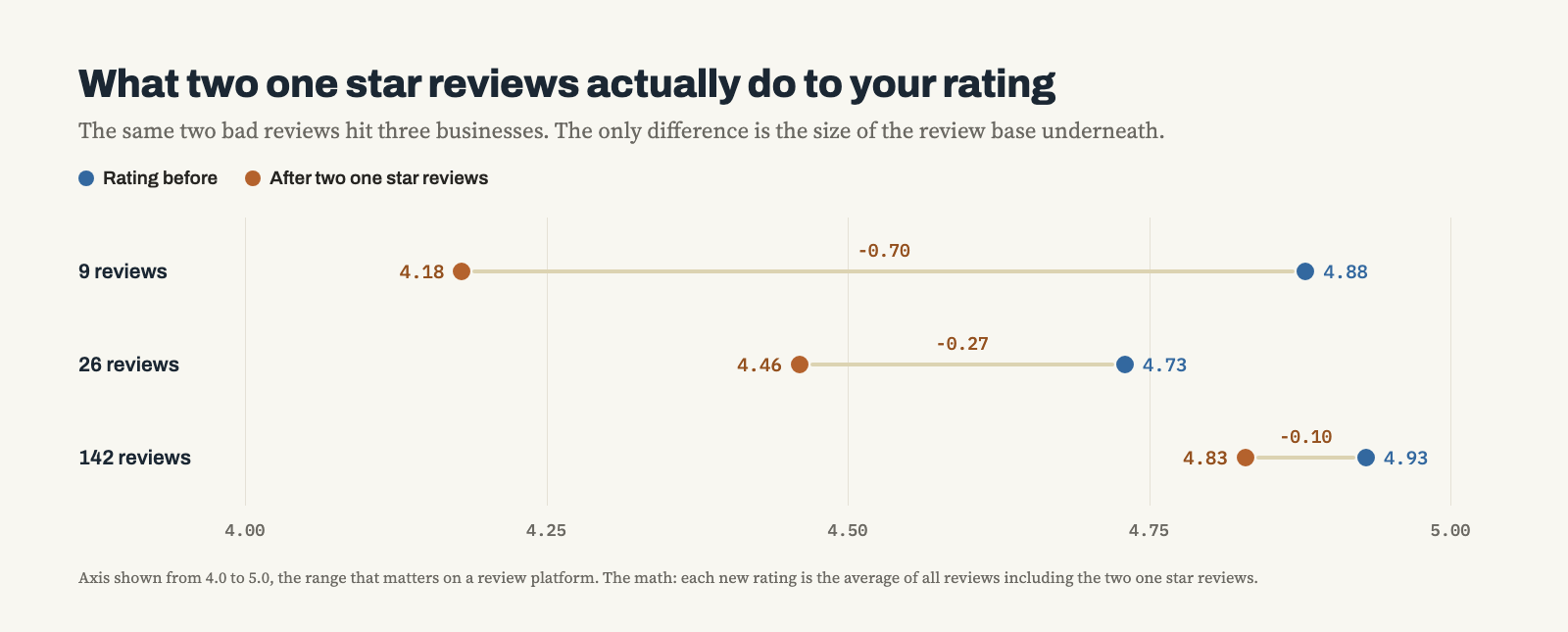
A business with only 9 total reviews sits at a 4.88 rating. They earned it through:
- 8 five star reviews
- 1 four star review
Now see how quickly things shift.
- After one one star review, the rating drops to 4.50.
- After a second one star review, it falls again to 4.18.
With a small review base, even a single negative review creates a major credibility problem.
Scenario 2
A business with 26 reviews holds a 4.73 rating. The mix looks like this:
- 21 five star reviews
- 3 four star reviews
- 2 three star reviews
After one one star review, the average drops from 4.73 to 4.59.
After another, it lands at 4.46.
Better than Scenario 1, but still too sensitive. Two negative reviews pull the rating down quickly.
Scenario 3
Now look at a business with a strong review foundation.
142 total reviews with an aggregate rating of 4.93.
The breakdown:
- 128 five star reviews
- 12 four star reviews
- 2 three star reviews
What happens with two one star reviews?
- After one one star review, the rating shifts only slightly to 4.86.
- After a second one star review, it moves again only to 4.83.
This business remains stable, trustworthy, and highly competitive. Customers see consistency because the foundation is large.
The Lesson: Build Review Volume Before You Need It
These scenarios show one clear truth. A large cluster of five star reviews gives your business stability. Instead of reacting to the occasional negative review, you absorb it. Your rating stays strong. Prospects continue to trust you. Competitors with weaker review bases fall behind.
When I train our clients on reviews, I use the same analogy every time: a castle with no moat versus a castle with a moat. The business with no reviews, or only a handful, is the castle with no moat. Nothing stands between an attacker and the walls. One bad review lands at the front door and everyone sees the damage.
The business with a deep review base is the castle with the moat, and every new five star review makes the moat wider and deeper. Stack enough of them and the moat is full of alligators. That castle is close to impenetrable, and anyone thinking about an attack can see it from a distance. Clients get the visual instantly, because it is exactly what the scenario math above shows.

If you operate in a competitive service market like HVAC, plumbing, propane delivery, or home services, this can be the difference between a customer choosing you or selecting a competitor. At Navara Marketing, we help our clients build review fortresses using the concepts in this article.
Think of your review volume as insurance for your reputation.
We also go one layer deeper than the software. The person who actually earns the review is the technician standing in the customer’s home, so that is who we train. We run in-person sessions with our clients’ field teams on review best practices: how to deliver an experience worth five stars, when and how to ask for the review, and how to use the review platform so the request goes out while the truck is still in the driveway. Marketing can build the system, but the person in the field is the one who makes it real.

How to Handle Negative Reviews the Right Way
Even with a strong review base, you will eventually get a one star review. Here is the best process for turning a negative into a positive.
Step 1. Respond quickly and professionally
Keep your response calm, respectful, and concise. Acknowledge the issue and invite the customer to connect offline. Your public response shows future customers that you care.
Step 2. Resolve the issue privately
This is where most reputation wins happen.
Call the customer. Listen. Fix the problem. Offer a fair resolution. When customers feel heard, they often soften immediately.
Step 3. Request an updated review
Once the issue is resolved, many customers gladly update their rating. A one star review can become a five star review when the experience ends well. This is the ideal outcome.
Step 4. Request removal when appropriate
If a review violates platform guidelines or contains inaccurate statements, you can request that Google or Yelp remove it. This works in situations like spam, false claims, personal attacks, or clear policy violations.
Why Reputation Management Is Essential Marketing
- Reviews influence everything in your marketing funnel.
- They improve your local rankings.
- They increase conversions on paid ads and landing pages.
- They build trust before a customer even visits your website.

A business with a high volume of five star reviews consistently outperforms competitors in both visibility and conversion.
A strong review strategy reduces risk, strengthens marketing performance, and builds long term credibility.
The New Layer: Your Reviews Now Feed AI Answers
Search itself has changed since this post first ran, and it changes what your reviews are worth. A growing share of buying decisions no longer starts with ten blue links. It starts with an AI answer: Google’s AI Overviews, ChatGPT, Perplexity, Gemini. A homeowner asks “who is the best propane company near me” and gets a synthesized recommendation naming two or three businesses. Either you are in that answer or you are invisible.
That shift created two new disciplines. AEO, answer engine optimization, is earning your place in the direct answers these engines give. GEO, generative engine optimization, is making your business present and credible in the sources generative AI reads before it writes. Different acronyms, same underlying question: when a machine assembles the answer, why should it pick you?
Reviews sit at the center of both. An AI engine does not take your word for how good you are. It weighs third-party evidence, and reviews are the richest third-party evidence that exists about a local business:
- Volume and rating still matter, but recency now matters more. A steady flow of fresh reviews tells the engine you are actively good, not historically good.
- The words customers write become the evidence. When reviews repeatedly mention your responsiveness, your techs, or your same-day service in a specific town, engines connect you to exactly those questions.
- Owner responses count. Engines read engagement as a trust signal, and so do the humans who click through to verify the AI’s answer.
Here is the compounding part. The review fortress this post describes was originally about protecting your rating from the occasional one star hit. In today’s search it does double duty: the same deep, fresh, specific review base is what gets you cited by the answer engines in the first place. Same asset, higher stakes. The businesses building review volume with intention are not just defending a number anymore. They are buying their seat in the answer.
Final Thoughts
Your reputation is not something you leave to chance. You build it with intention. You protect it with consistency. You leverage it as a competitive advantage.
The math is clear. The business with a deep foundation of five star reviews wins. Not because they never have problems, but because they are prepared for them.