Systems Over Willpower
Willpower is a tax you pay every single day. A system is a bill you pay once.
I run three businesses that could not be more different from each other. A marketing agency, a wellness company with my wife, and a real estate portfolio that spans two states. For a long time I believed the thing holding all of that together was me. My focus, my memory, my willingness to grind.
And for a long time that was actually true, which is exactly the problem.
The thing you keep meaning to do
Here is something I do not say out loud very often.
For most of my career I was full of good ideas I never executed. Not a few of them. Most of them. I would see the opportunity, I would know exactly what to build, and twelve months later it would still be sitting in a notebook.
I used to think that was a discipline problem. That if I just wanted it badly enough, I would eventually get to it. That belief cost me years.

It was never about wanting it. The ideas I executed were the ones that had a system behind them. The ideas that died were the ones that depended on me remembering, on a good week, to care about them again.
Motivation is not a plan. It is a mood.
What changed for me was not my work ethic. I have always worked hard. I get up early and I work late. What changed is that I stopped trying to be the kind of person who does the thing, and started building the thing that does the thing.
What a system actually is
I want to be precise here, because the word has been mutilated by software companies.
A system is not software. You can buy every tool on the market and still have nothing. Plenty of owners do exactly that, chasing the next platform that promises to fix the problem.
A system is a decision you only have to make one time.
Here is what that looks like in practice. I hate bookkeeping. My real estate bookkeeping used to live in my head. Statements would come in, I would mean to get to them, and three or four months later I would be reconstructing a quarter I could barely remember. Every single month I had to decide, again, whether today was the day I dealt with it.
Now the statements land in a defined place. They get coded by rules I wrote one time. The books are current whether I thought about them or not.
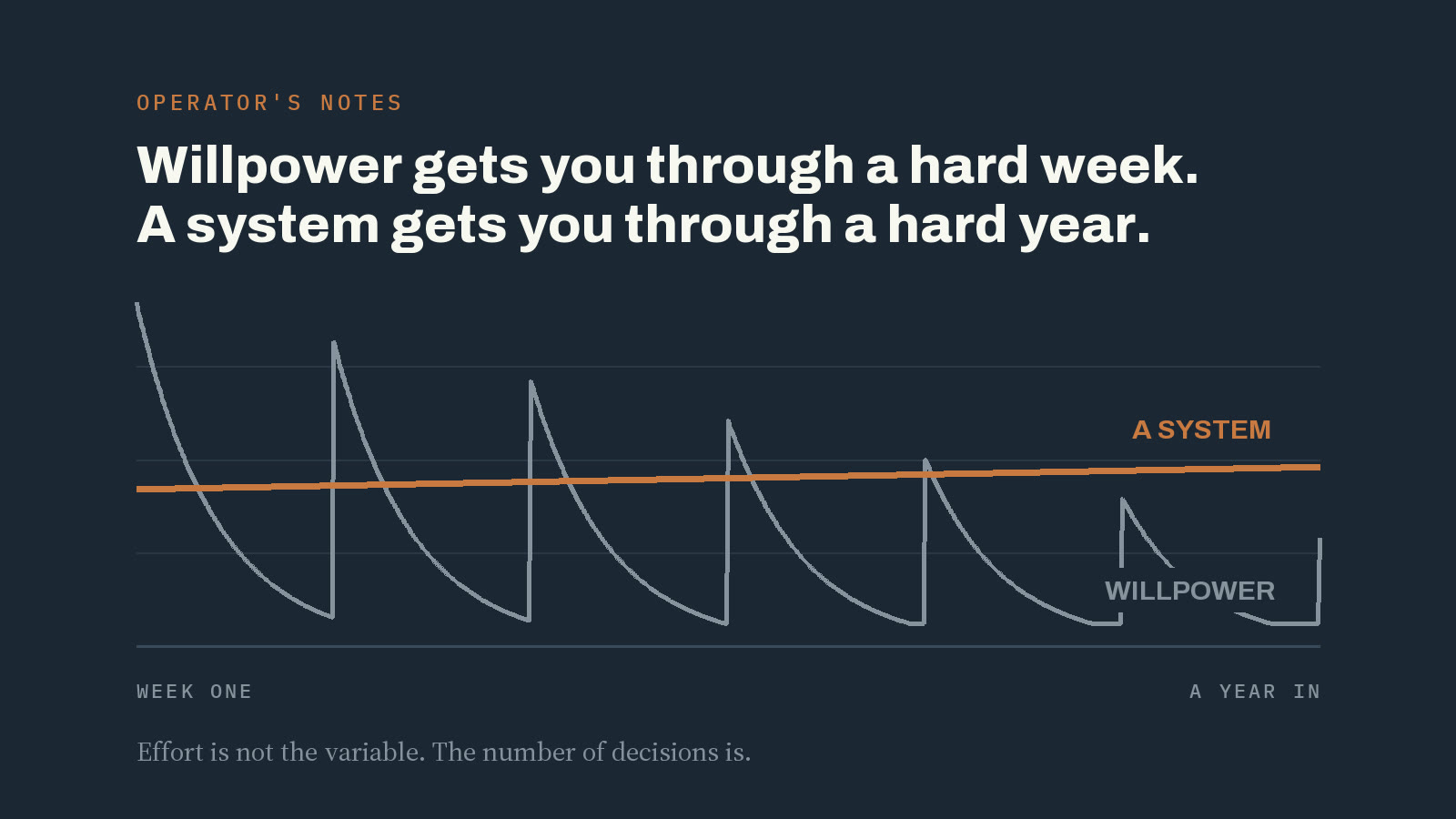
The work did not get smaller. The deciding got smaller. That is the whole trick. You are not trying to reduce effort. You are trying to reduce the number of times you have to choose.
Build where you are failing, not where you are strong
Most owners build their first system in the wrong place. I did this too.
When you finally decide to get systematic, the instinct is to start with the part of the business you are already good at. It feels productive. It is not. You are optimizing something that already works.
Build the system where you are failing. Where you procrastinate. Where you are a little embarrassed. That is the highest return available to you, because you are not making a good thing marginally better. You are converting a zero into a one.
For me that was the accounting and the paperwork. I avoided it for years. I am not temperamentally suited to it and I never will be. So I stopped trying to become someone who enjoys it, and I built something that does not require me to enjoy it.
Your worst area is not a character flaw to fix. It is the biggest unclaimed asset you own.
What I got wrong about systems
I expected systems to make the business feel mechanical. Cold. Less mine.
The opposite happened. Every decision I stopped having to make gave me back room for the ones that actually need me. Strategy. Hiring. Where we go next. The work only I can do.

This is the same idea I wrote about when we train our clients’ field teams: the system can be built by marketing, but the person in the field is the one who makes it real. Structure does not replace people. It frees them to do the part that matters.
You do not build systems to remove yourself from your business. You build them to put yourself where you are worth the most.
Willpower gets you through a hard week. A system gets you through a hard year.